Copier Trading: What a Trade Copier Does, Clear 2026 Guide
Copier trading means letting software repeat one account's trades on your other accounts. A trade copier watches the sender, and each receiver gets its own copy a moment later, sized by a rule you pick. What it's worth in practice depends on where it runs, how it sizes each copy and what it does with a late one.
TPcopier copies MetaTrader 4 and 5 and binary options, and every setting named here is one of its real ones. The latency figure is measured, and nothing here promises profit.
What is a trade copier doing after you trade?
Every copier runs the same loop. It watches the sender, and when a new position opens it works out each receiver's size, translates the symbol if the brokers spell it differently and sends each receiver an order. Closes and stop loss changes travel the same path.
The names change by vendor, and so does the product's own name: some sell a copier trader, others a trade copier. MetaTrader's signal service says provider and subscriber, while TPcopier says sender and receiver. ESMA, the EU's markets regulator, uses "copied trader" and "copy traders" in its supervisory briefing on copy trading of 30 March 2023.
In TPcopier's MetaTrader copier, each link between two accounts is a pipeline. One sender can feed many receivers. A receiver, though, has one sender and pipelines never chain, so a copy can't loop back.
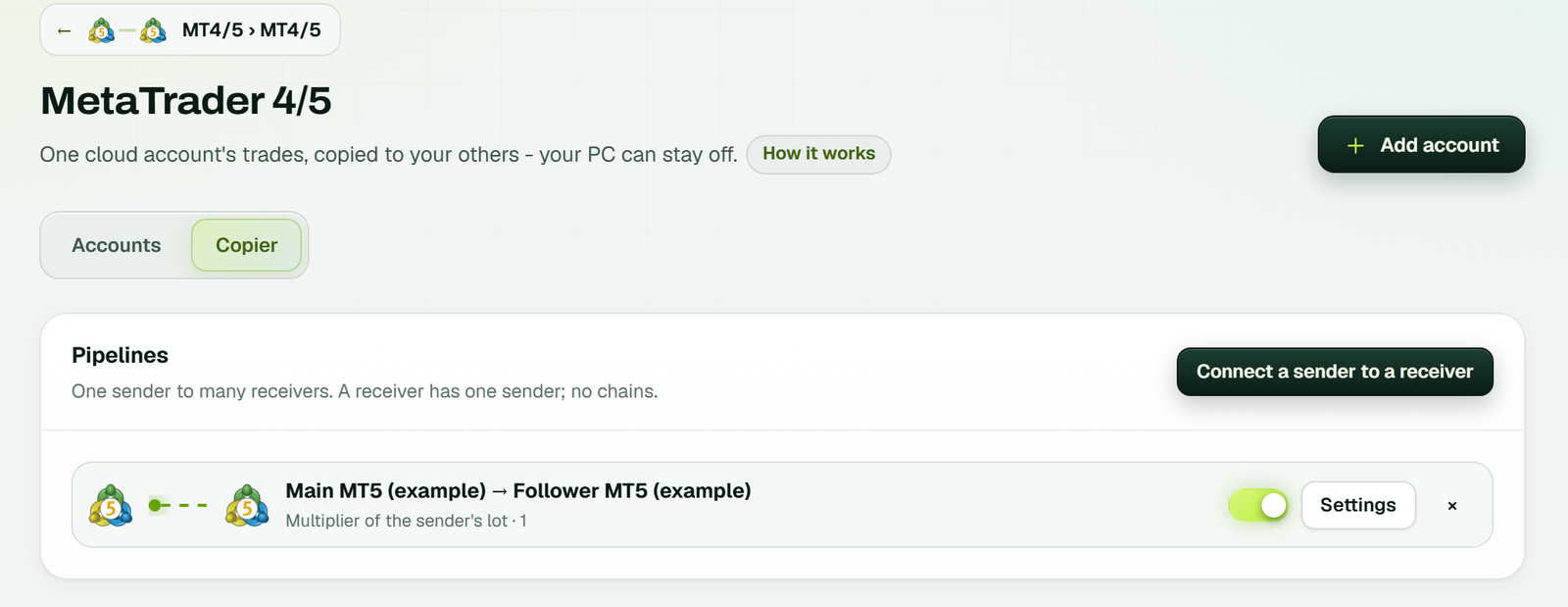 This pipeline copies at the sender's own lot size, shown under its name as "Multiplier of the sender's lot · 1" (example workspace).
Signal copier or trade copier?
Vendors sell them side by side, so people mix them up. A signal copier starts from a message, such as a Telegram post or a TradingView alert, and reads the text to decide whether it's a trade. A trade copier starts from an account. It reads nothing; it sees a position open and repeats it.
That changes what can go wrong. A signal copier has to understand a message like "gold buy now 2350 to 2355". A trade copier never does, because the sender's order is already clean. Its weak spots are sizing and timing.
The two also work together. If a signal copier places a trade on your main account, the trade copier copies it to the followers like any other. TPcopier's binary trade copier also copies trades you place by hand on the broker's own site or app.
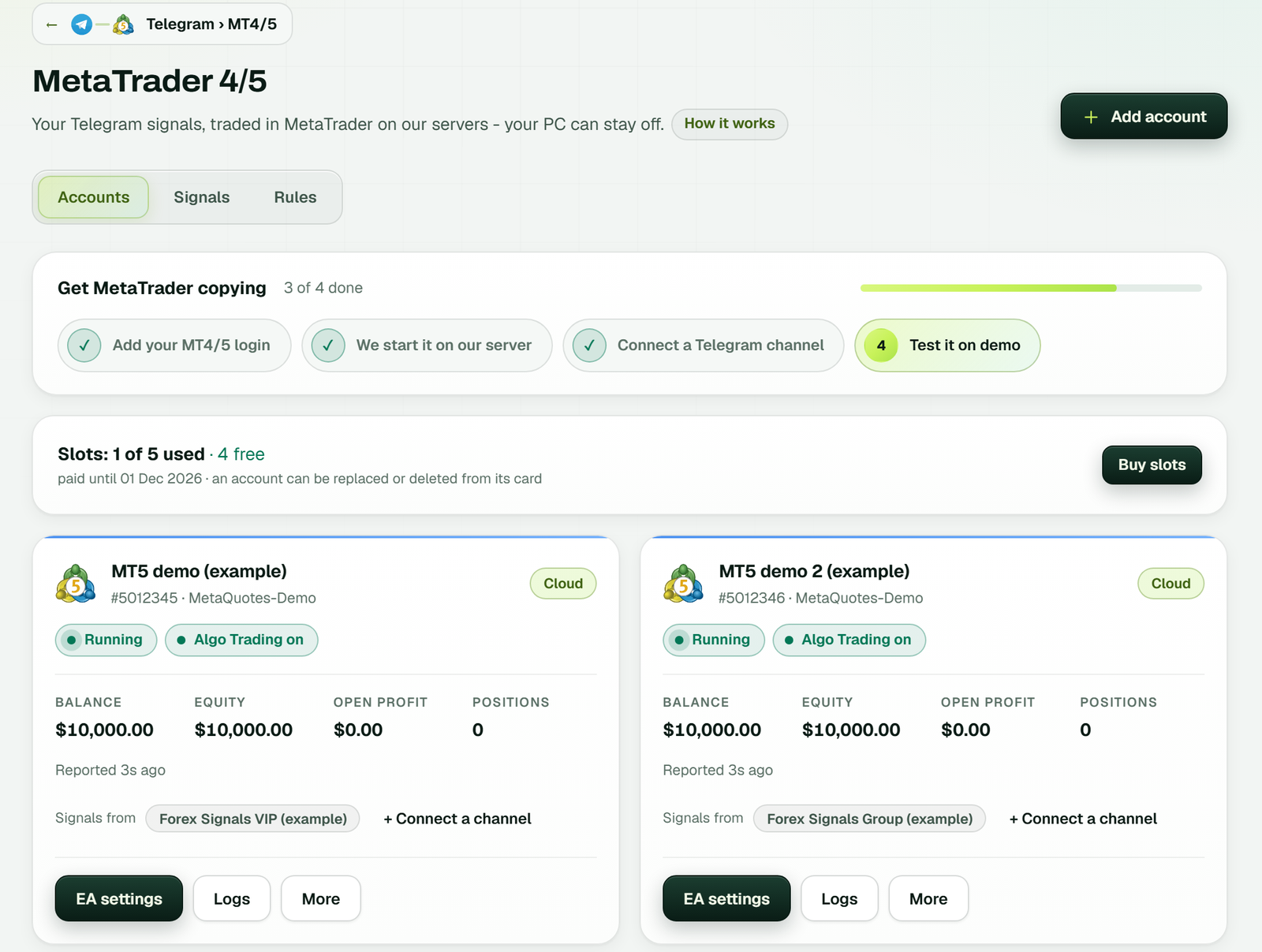 For comparison, the signal side: on a Telegram to MT4/5 bridge each card follows a channel ("Signals from") instead of another account (example workspace).
If your trades come from a channel, you want a bridge such as the Telegram to MT4/MT5 cloud copier.
Local or cloud: where the copier runs
The machine a copier lives on decides whether it keeps copying while you sleep. The MetaTrader 5 help page for signal subscribers says the account has to stay on and connected for copying to work. It suggests a VPS, and says a VPS can also cut network latency.
A local copier is an Expert Advisor or desktop app on your own PC, and it copies only while that PC and its internet are up. A Windows update at 3 a.m. pauses your copying until you notice. A rented VPS fixes the uptime, but it's a second bill.
A cloud copier moves all of it to the vendor's servers. With TPcopier you add the account number, broker and password in one window, and TPcopier starts MetaTrader on its own server with Algo Trading on, so your PC can stay off.
The password is locked with the cloud server's own key when you press Add it, and the website can never read it again. A sender's trades are only read, so its investor (read-only) password is enough. A receiver places orders, so it needs the trading password.
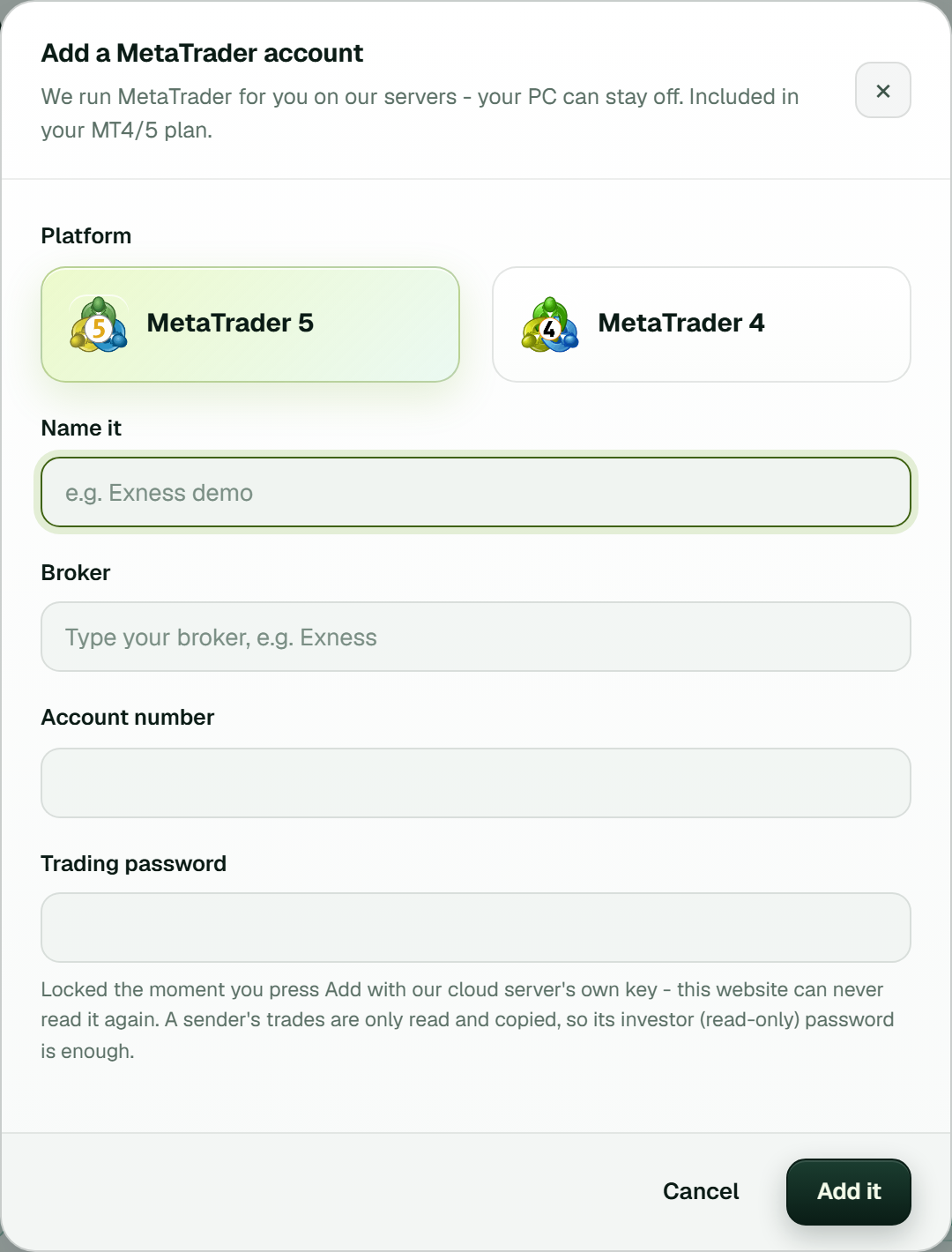 Pressing Add it starts the terminal on TPcopier's server; the note under the password field covers the investor password.
Local still has its place, for example if you'd rather pay once. TPcopier lists a pay-once trade copier software that copies one binary account to many from a Windows PC for $150, but its download is still being prepared, so for now that copier runs in the cloud. The cloud vs VPS comparison weighs the two on cost and uptime.
Latency: what the milliseconds mean
Speed is the first thing vendors quote, so here's a measured figure with its limits. On live MT4/MT5 copies on 4 October 2026, TPcopier's median time from seeing the sender's trade to sending the receiver's order was 7 ms (published in TPcopier's llms.txt). The receiver's broker then took about 140 ms to execute it.
The copier's part is the small one, and no copier makes your broker fill faster. When a service says it's fast, ask where it stopped the clock.
When price moves quickly, the cost shows up as slippage. The receiver fills a few points away from the sender. In TPcopier's pipeline Settings, "Most slippage (points)" caps it at 20 unless you change it.
A very late copy is the bigger danger. Say the copier reconnects after a drop and finds a position that opened a minute ago: copying it now would open a different trade at a different price, so TPcopier skips it. The MetaTrader setting "Skip a trade older than (seconds)" starts at 5. The binary trade copier skips a deal it first sees more than 8 seconds after it opened.
Lot sizing decides your risk
Of all the settings, the lot rule is the dangerous one. A copy at the wrong size is how a copier hurts people, because the size sets the loss.
TPcopier's MetaTrader pipelines offer four lot rules:
- Multiplier of the sender's lot. At 1 the copy matches the sender, and at 0.5 it's half. This is the default.
- Fixed lot: every copy uses the lot you set.
- By balance ratio: the sender's lot times the receiver's balance divided by the sender's balance, times your value.
- Risk % of balance: sized so the sender's stop loss would lose that share of the receiver's balance. A trade with no stop loss isn't copied under this rule.
Here's the balance ratio with round example numbers. The sender holds $10,000 and opens 1.00 lot. A receiver with $2,000 then gets 0.20 lot at a value of 1. MetaTrader's own signal service uses the same balance idea, and its help page shows it also scales down for lower leverage.
Every result is then rounded down to the broker's lot step. It also stays between the "Smallest lot" and "Largest lot" you set. On a small account that matters: a calculated 0.015 lot becomes 0.01.
Binary options use stakes, not lots. A binary options trade copier like TPcopier's gives each follower one rule: the main stake, a fixed amount or a multiple of the main stake. The first and last only work between accounts in the same currency. Across currencies, use a fixed stake.
Copier trading and copy trading
People search for the two terms as if they meant one thing. The first usually means software between accounts you control, and you decide each trade. The usual copy trading meaning is a platform where you pick another trader from a list.
ESMA's briefing deals with that second kind. It recalls a 2012 ESMA answer: a firm that executes trades from signal providers the client chose, with no further client action, needs authorisation for portfolio management.
A trade copier belongs to the first group. It doesn't pick or rank traders, and it gives no advice. If you're unsure where your set-up sits, read the guide on whether copy trading is legal.
Risks a copier adds, and how to test for them
A copier doesn't make a trade better; it repeats it, so a losing day on the sender is a losing day on every receiver. Test these failure points before real money:
- A symbol that doesn't match. Brokers call gold XAUUSD, GOLD or something with a suffix. TPcopier matches names itself, and its Symbol names box (XAUUSD=GOLD) fixes a wrong match.
- A receiver with no limit of its own. A pipeline can stop for the day after losing a set percentage of balance, and cap open positions. Binary followers keep their own daily stop, and the red Stop Trading button stops all trading at once.
- Reverse switched on by mistake. "Reverse (a buy becomes a sell)" is for hedging, and it flips every copy on that pipeline.
The test itself is short. Connect two demo accounts on one pipeline at a multiplier of 1, place a small trade on the sender and check the receiver's size. Then close it and check the close copied too. For binary accounts, History on the Dashboard lists every order.
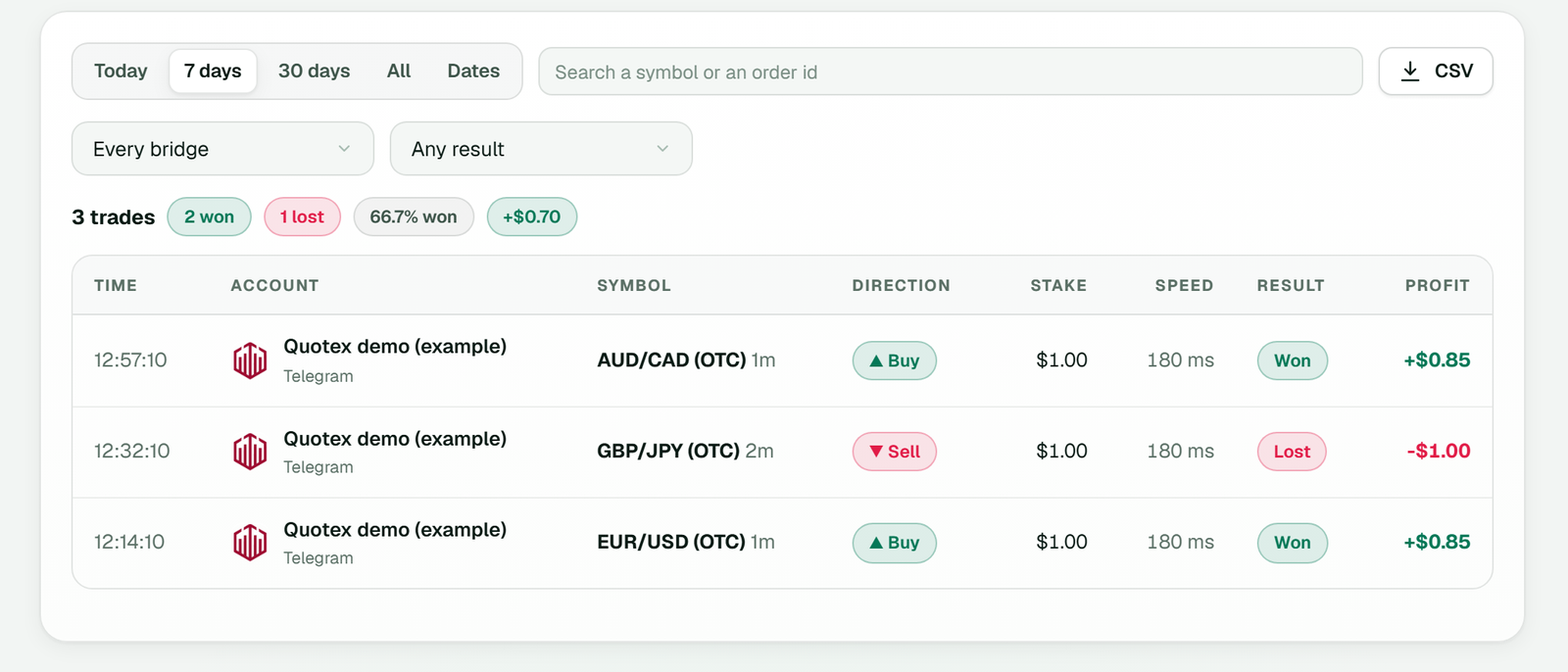 History keeps every binary order, so a test can be checked line by line or downloaded as CSV (example workspace).
Binary options carry a high risk of losing each stake, and ESMA prohibited their sale to retail investors in the EU. India's RBI keeps an alert list of unauthorised forex platforms, and several binary brokers are on it. TPcopier is software, not a broker, and nothing here is trading advice. Trading can lose money.
How much a trade copier costs a month
The MT4/MT5 trade copier costs $6 a month per account, with MetaTrader in the cloud; binary copying is $30 a month for the first account plus $10 for each extra. Both have a 2-day free trial with no card, and nothing renews by itself. See the pricing page, or the trade copier cost comparison against other services.
For a first MetaTrader pipeline, the MT4/MT5 cloud trade copier page lists what it copies, and the MT4 to MT5 trade copier guide sets one up between two brokers.
FAQ
Is copy trading profitable?
A copier repeats trades, so your result is the copied account's result, scaled by your lot rule, minus costs. Past results don't promise future ones, and trading can lose money.
Can a trade copier copy between different brokers?
TPcopier's MetaTrader copier works across brokers and matches symbol names. The binary trade copier copies within one broker only, so a Quotex trade goes to Quotex followers.
Does MT5 allow copy trading?
Yes, through its built-in Signals service, where a subscriber also caps how much of the deposit the copies may use with "Use no more than". A trade copier replaces that cap with its own lot rule and works between any accounts you hold.
Does a copied trade cost more than the original?
It can. Each receiver pays its own broker's spread and commission, and a fast market adds slippage, which TPcopier caps at 20 points by default.
Sources
- ESMA35-42-1428, 30 March 2023 (copy trading briefing), read 4 November 2026.
- MetaQuotes, MetaTrader 5 terminal help, Signals section, read 4 November 2026.
- ESMA press release of 27 March 2018 on binary options and CFDs.
- Reserve Bank of India, Alert List (updated 19 November 2025), read 4 November 2026.
- TPcopier llms.txt and the Local Software page: prices, the 7 ms median of 4 October 2026, read 4 November 2026.